Uncovering the Majesty of Chichen Itza’s Ancient Architecture
Stepping into Chichen Itza feels like walking through a living history book. The towering pyramids, intricate stone carvings, and symmetrical layouts are more than just impressive—they tell stories of a civilization far ahead of its time. As sunlight hits the corners of El Castillo during the equinox, shadows dance like ancient gods. This isn’t just sightseeing—it’s a journey into genius architectural design shaped by astronomy, religion, and power. Every stone seems placed with purpose, every alignment calculated with precision. For modern travelers, especially those seeking meaningful experiences beyond the ordinary, Chichen Itza offers a rare window into human ingenuity. It invites quiet reflection, deep curiosity, and a renewed appreciation for how ancient minds shaped the world without modern tools.
First Impressions: Arriving at Chichen Itza
The journey to Chichen Itza begins long before the first pyramid comes into view. Nestled in the Yucatán Peninsula of Mexico, the site emerges from a landscape of low jungle and limestone plains, where the air carries the scent of dry earth and tropical foliage. Early morning visitors are greeted by a soft golden light that filters through the trees, casting long shadows across the ancient pathways. As the sun rises, the temperature begins to climb, but the coolness of dawn lingers just long enough to make the first steps into the site feel refreshing. The sound of footsteps on the stone walkways echoes faintly, blending with the distant calls of birds and the rustle of leaves in the breeze.
What sets Chichen Itza apart from the moment of arrival is its sheer scale and order. Unlike some archaeological sites that feel scattered or overgrown, Chichen Itza presents itself with clarity and intention. The layout is expansive yet organized, with major structures aligned along clear axes, connected by wide sacbeob—raised white limestone roads that once linked ceremonial centers. The visual impact is immediate: a skyline dominated by geometric precision, where pyramids rise like monuments to human ambition. The contrast between the natural jungle and the deliberate symmetry of the architecture creates a powerful sense of discovery.
For many visitors, especially women between the ages of 30 and 55 who travel for both enrichment and connection, this first encounter is deeply moving. It is not merely the size of the ruins that impresses, but the sense of presence—the feeling that this place still holds energy, history, and wisdom. There is no rush here, no pressure to move quickly from one point to the next. Instead, the atmosphere encourages a slower pace, inviting contemplation and observation. The initial moments at Chichen Itza are not about checking off a bucket list; they are about stepping into a world where time feels different, where the past speaks in silence and stone.
El Castillo: The Heart of Mayan Cosmic Design
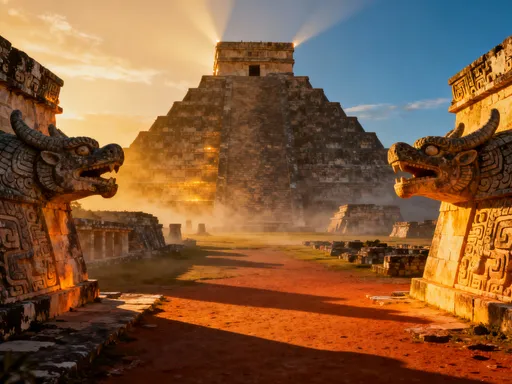
Rising 30 meters above the Great North Platform, El Castillo, also known as the Temple of Kukulcán, stands as the centerpiece of Chichen Itza. Its pyramid form, with four staircases leading to a single temple at the summit, follows the classic Mesoamerican style, yet its design reveals an extraordinary level of sophistication. Each of the pyramid’s four sides contains 91 steps, and when combined with the final step at the top platform, the total reaches 365—the number of days in the solar year. This deliberate numerical alignment is no coincidence; it reflects the Maya’s deep integration of timekeeping, agriculture, and cosmology into their architecture.
The pyramid is precisely aligned with the cardinal directions, a feat achieved without compasses or modern instruments. The north staircase, in particular, plays a crucial role in one of the most famous astronomical events at the site—the spring and autumn equinoxes. On these days, as the sun sets, a remarkable phenomenon occurs: a series of triangular shadows forms along the northern balustrade, gradually creating the illusion of a serpent descending from the top of the pyramid to the base. This serpentine shadow aligns perfectly with the carved stone head of a feathered serpent at the bottom, symbolizing the descent of Kukulcán, the Maya feathered serpent deity associated with wisdom, fertility, and renewal.
The nine terraces of El Castillo are also rich in symbolism. In Mayan cosmology, the number nine represents the nine levels of the underworld, or Xibalba, and the pyramid’s stepped structure may have been designed to mirror this spiritual journey. Climbing the pyramid—though no longer permitted for safety and preservation reasons—would have been a ritual act, a physical ascent that mirrored a spiritual one. The temple at the top once housed sacred chambers where priests conducted ceremonies, possibly involving offerings, prayers, and astronomical observations. Even today, standing at the base and looking upward, one can sense the reverence such a structure would have inspired.
What makes El Castillo truly remarkable is not just its religious or symbolic meaning, but the precision with which it was constructed. The Maya had no metal tools, no wheels, and no draft animals, yet they engineered a building that functions as both a temple and a calendar. This fusion of science and spirituality speaks to a civilization that saw no separation between the natural world and the divine. For modern visitors, especially those who value knowledge and introspection, El Castillo is not just a monument to admire—it is a lesson in harmony, balance, and the enduring power of human thought.
The Temple of the Warriors: Power in Stone and Columns
Just north of El Castillo lies the Temple of the Warriors, a sprawling complex that showcases the political and military might of Chichen Itza during its peak. This structure is surrounded by a forest of massive stone columns, each carved with intricate reliefs of warriors, jaguars, and eagles—symbols of strength and authority. The temple itself sits atop a stepped pyramid, accessible by a grand staircase flanked by two large columns carved in the likeness of feathered serpents. Unlike the solitary grandeur of El Castillo, the Temple of the Warriors conveys a sense of collective power, as if the entire complex was designed to impress and intimidate.
The rows of columns, some still standing, others fallen, once supported a vast roof system, suggesting that this was not just a ceremonial space but also a gathering hall for elite classes or military leaders. Archaeologists believe the site may have been used for public rituals, political assemblies, or even judicial proceedings. The carvings on the columns depict warriors in elaborate attire, carrying shields and weapons, often accompanied by glyphs that may record names, titles, or historical events. These images reinforce the idea that Chichen Itza was not only a religious center but also a seat of governance and military influence.
One of the most striking features of the temple is the Chac Mool statue found at the top of the staircase. This reclining figure, with its head turned at a 90-degree angle and a bowl resting on its stomach, is believed to have been used to hold offerings—possibly food, incense, or other sacred items. The Chac Mool is a recurring motif in Mesoamerican architecture, but its prominence here underscores the blending of religious and political power. The temple’s design, with its elevated platform and expansive courtyard, would have allowed large crowds to gather below, watching ceremonies unfold above—a visual reminder of the hierarchy and order that defined Mayan society.
For visitors, especially those interested in history and cultural evolution, the Temple of the Warriors offers a deeper understanding of how architecture can serve multiple purposes. It was not built merely for worship, but as a statement of dominance and unity. The precision of the columns, the symmetry of the layout, and the durability of the stone all speak to a civilization that valued both beauty and function. Walking among the ruins, one can almost hear the echoes of ancient voices, the rhythm of drums, and the presence of leaders who once stood where we now stand, looking out over their domain.
El Caracol: Ancient Astronomy in Architectural Form
Among the many structures at Chichen Itza, El Caracol—the Observatory—stands out for its unique circular shape, a rarity in Mayan architecture, which typically favored rectangular and pyramidal forms. Perched on a large square platform, this two-story tower features a spiral staircase inside, which gives the building its name ("El Caracol" means "the snail" in Spanish). Built during the late Classic to early Postclassic period, El Caracol is widely recognized as one of the most advanced astronomical structures of the ancient Americas. Its design reflects a deep understanding of celestial movements, particularly those of Venus, which held great significance in Mayan cosmology.
The tower’s windows and doorways are strategically positioned to align with key astronomical events. Observations from within the structure would have allowed Mayan astronomers to track the movements of the sun, moon, and planets with remarkable accuracy. For example, certain windows align with the northernmost and southernmost positions of Venus on the horizon, marking its appearance as both the morning and evening star. Other sightlines correspond to the summer and winter solstices, when the sun reaches its highest and lowest points in the sky. These alignments were not accidental; they were the result of generations of careful observation and record-keeping.
The Mayans did not view astronomy as a separate science but as an integral part of their religious and agricultural life. The movements of Venus, for instance, were believed to influence warfare and ritual timing. Kings may have consulted astronomers before launching military campaigns, ensuring that celestial conditions were favorable. The knowledge preserved in El Caracol would have been closely guarded, likely accessible only to a select group of priest-astronomers who combined scientific inquiry with spiritual practice. Their calculations were so precise that modern scholars have confirmed the accuracy of Mayan calendars centuries after their creation.
For today’s travelers, El Caracol offers a profound reminder of how ancient cultures sought to understand the universe. Unlike modern observatories filled with telescopes and digital instruments, this structure relied on pure geometry, patience, and observation. Standing near its base, one can imagine the quiet dedication of those who once watched the skies from within its walls, recording patterns that would guide their people through time. It is a testament to human curiosity and the universal desire to find meaning in the stars—a desire that continues to inspire us today.
Ball Court Acoustics and Sacred Geometry
The Great Ball Court at Chichen Itza is the largest and best-preserved of its kind in Mesoamerica, measuring 168 meters in length and 70 meters in width. Flanked by two towering walls rising over 12 meters high, the court forms a narrow, elongated rectangle that creates a striking visual and acoustic experience. This was not merely a sports arena; it was a sacred space where ritual, politics, and cosmology converged. The game played here, known as pok-ta-pok, involved two teams using their hips to propel a heavy rubber ball through stone rings mounted high on the walls. The stakes were often high—some historical accounts suggest that the outcome could determine leadership or even involve sacrifice—but the deeper meaning of the game was symbolic, representing the struggle between light and darkness, life and death.
One of the most astonishing features of the ball court is its acoustics. A whisper spoken at one end can be clearly heard at the other, a phenomenon that would have been both practical and ceremonial. Priests or officials standing at opposite ends could communicate across the vast space without raising their voices, creating an almost mystical effect for onlookers. This acoustic precision suggests that sound played a key role in rituals, possibly enhancing the spiritual atmosphere or allowing chants and drumming to resonate throughout the court. The symmetry of the structure—its perfectly aligned walls, leveled playing surface, and balanced proportions—reflects the Mayan emphasis on harmony and order in both architecture and belief.
The stone rings, positioned 6 meters above the ground, are adorned with carvings of intertwined serpents, reinforcing the religious significance of the game. The ball itself may have symbolized the sun, and the movement of the game could have mirrored the journey of celestial bodies across the sky. The court’s orientation also aligns with celestial events, further linking the physical space to the cosmos. For visitors, standing in the center of the court evokes a powerful sense of awe. The scale is immense, the silence profound, and the imagination easily fills the space with the sounds of ancient crowds, the thud of the ball, and the chants of participants.
What makes the Great Ball Court particularly compelling for modern audiences is how it combines physical challenge, spiritual meaning, and architectural brilliance. It was not just a place of entertainment, but a stage for enacting cosmic dramas. For families and thoughtful travelers, especially women who appreciate depth and symbolism in cultural experiences, the ball court offers a vivid connection to a worldview where every action had meaning, and every structure told a story.
Beyond the Main Sites: Hidden Architectural Gems
While El Castillo and the Great Ball Court draw the most attention, Chichen Itza is home to many lesser-known structures that reveal the evolution of Mayan architectural styles over time. The Nunnery Quadrangle, a complex of four elongated buildings surrounding a central plaza, is one such example. Its name, given by Spanish explorers, is misleading—there were no nuns here—but the intricate façades and detailed carvings make it one of the most artistically refined areas of the site. Each building features multiple levels of decorative elements, including masks of the rain god Chaac, geometric patterns, and glyphs that may record historical events or astronomical data.
The Platform of Venus, located near the Temple of the Warriors, is another significant but often overlooked structure. Dedicated to the planet Venus, it served as a ceremonial platform where observations and rituals related to the planet’s cycles were conducted. Its alignment with key Venus events suggests that it functioned as an auxiliary to El Caracol, reinforcing the importance of astronomy in Mayan life. The platform’s elevated position would have provided clear views of the horizon, essential for tracking celestial movements.
These secondary structures demonstrate how Chichen Itza was not built all at once, but developed over centuries, incorporating influences from different regions and periods. The mix of Puuc and Maya-Toltec architectural styles reflects a city that was both innovative and cosmopolitan. The use of decorative stone mosaics, vaulted ceilings, and precise masonry techniques shows a high level of craftsmanship and planning. For visitors willing to explore beyond the main attractions, these quieter areas offer moments of solitude and deeper insight into the daily and spiritual lives of the people who once inhabited this place.
Walking through the Nunnery Quadrangle or pausing at the Platform of Venus, one gains a fuller appreciation for the complexity of Mayan urban design. These spaces were not isolated monuments, but interconnected parts of a larger system—a city where religion, science, and governance were woven into the very fabric of architecture. For thoughtful travelers, especially those who value learning and quiet reflection, these hidden gems provide some of the most meaningful experiences at Chichen Itza.
Preservation, Tourism, and Respectful Exploration
As one of Mexico’s most visited archaeological sites, Chichen Itza faces ongoing challenges related to preservation. The constant flow of tourists, combined with exposure to tropical weather, wind, and humidity, can accelerate the erosion of stone surfaces and weaken structural integrity. In response, Mexican authorities and international conservation organizations have implemented measures to protect the site, including limiting access to certain areas, installing protective barriers, and conducting regular maintenance. Climbing El Castillo, once allowed, is now prohibited to prevent further wear on the ancient steps.
Visitors play a crucial role in preservation. Simple actions—staying on designated paths, not touching carvings, avoiding littering, and refraining from removing stones or debris—can make a significant difference. Using eco-friendly sunscreen and staying hydrated are also important, as the Yucatán climate can be intense, especially during midday. Travelers are encouraged to visit early in the morning or later in the afternoon, not only to avoid the heat but also to reduce crowding and allow for a more peaceful experience.
Respectful exploration means more than following rules; it means approaching the site with a sense of humility and appreciation. Chichen Itza is not just a collection of old buildings—it is a cultural treasure that continues to inspire awe and wonder. Every stone was placed with intention, every alignment calculated with care. To walk through this ancient city is to engage with the legacy of a people who mastered astronomy, engineering, and art without modern technology.
For women who travel to learn, to grow, and to connect with history, Chichen Itza offers more than beautiful photos or a stamp in a passport. It offers a moment of connection with human brilliance across time. The architecture here does not just reflect the past—it speaks to the present, reminding us that wisdom, creativity, and reverence for nature are timeless. As the sun sets and the shadows lengthen across the plazas, one cannot help but feel a deep sense of gratitude—for the builders, for the knowledge they left behind, and for the opportunity to witness such enduring majesty.